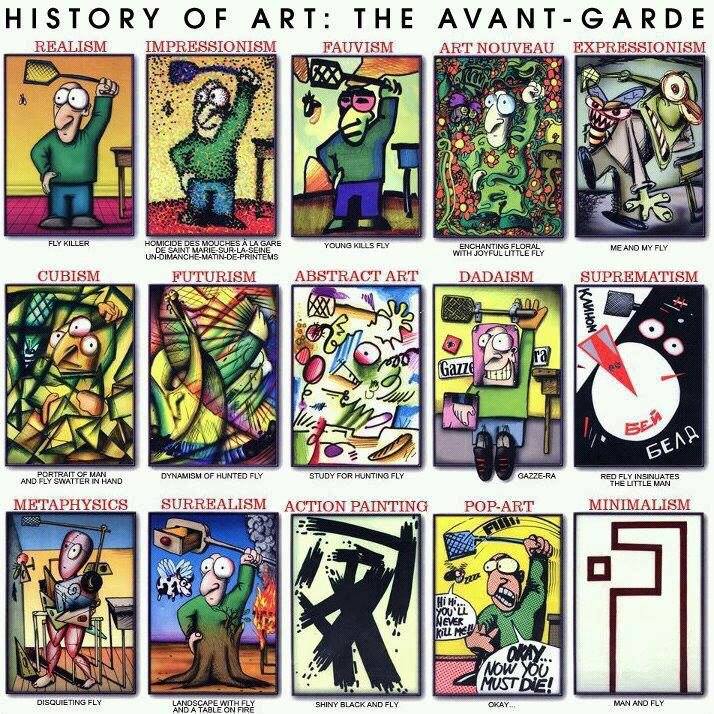
Modern art started by reasoning against the traditional and
known art image in the ways of exposing brush strokes, evading the one point
perspective and the vanishing point and also ignoring depth perception rules in
a three dimensional space. This movement was about stirring out of the
traditional forms of art and presenting new argumentive topics to embrace art
as it is. Based on that, a shift was formed to evaluate art from the
concealment of it to the complete reveling of it. That was evident in the
insistence on exulting brush strokes as in Paul Cezanne paintings in the
1860’s, more indications of the perseverance to break the emphasis on the one
point perspective and the effort on evading the vanishing point from painting
as in Edouard Manet’s work in “the music of the tuileries garden” in 1862 that
marked the desecration of depth perception as said by John David Albert in his
book “art after metaphysics” 2013. This transference proposed the notion of
“art for art’s sake,” which means to create for the sake of creating, To
explain further Clement Greenburg, a known art critique, relates, in his essay
from the collective essay and criticism 1993, the start of modern art to the
philosopher “Kant” as he points out the ideology of establishing logic for the
limit of logic. This changed the face of art in our day. As artists take this
matter to the extreme meaning and combine what was once considered art with
what is now thought of as the reason behind art. This alteration gave artists
the opportunity to discover new mediums and ways of expression. They projected
different and fresh agents that traditionally would not have been used as art.
In conclusion modern art rebelled against the norms of art not only by exposing
brush strokes and breaking the essential rules of creating three dimensional
space in a two dimensional surface. Yet that exact ideology proposed somewhat
of popular art forms or which were later called “the kitsch.”
 |
| Barbara Kruger |
The stimulation of new forms of avant-garde in the
contemporary times required a rapid level of variation that affected the
definition of kitsch. The roaring of the avant-garde pushed the modernism
movement further into the philosophy of formulating new art statements.
Duchamp, a modern artist, generates in his art piece under the title of
“fountain” a higher perspective of what avant-garde is capable of being. The
principle of avant-garde is to stand out in the sense of creating new
perspectives of new levels of perceptions to what art could be about. However
it is not a limitation but more of infinite grounds. It is simply the complete
evocation of overcoming the norms, which basically works against the idea of
the “kitsch”; an example of that evocation would be the work of Andrea Fraser in
“little frank and his carps.” When she valiantly imposed a rather sexual and
eccentric exposer of what art could be. She later on continues to interpret
this concept and execute it to its extremes. With that being accomplished, the
piece eventually turns from avant-garde into kitsch, in conjunction to the
public’s later approval to what this art piece persuades. In the sense that the
avant-garde can measured by the publics contrast to the artwork or even the
movement it’s self with that kitsch would be the public’s approval to it.
Indeed this implies that avant-garde can and does elaborate to the maximum
point of “kitsch”. When does the avant-garde become the kitsch? It is only when
the public agrees on the proposed idea. The problematic approach of the avant-garde
is about critiquing the current, opposite to that of kitsch creating what is
current. The approval of the public made the avant-garde turn to kitsch, but
how did the public approve of what is working against the awareness of the
masses? The influence of modern advertising made the shocking approach of the
avant-garde a bit less shocking and a little more accepting.
 |
| Barbara Kruger |
Modern advertising started in the established stages of modern
art with the philosophy of the avant-garde. Advertising is the result of modern
art’s absolute alteration. In the 1920’s, Publicity was the only system to make
something popular. It was the only form of familiarizing the latest ideas at
that time. This comprehension of publicity’s keen effect on the public made
albert Lasker, an American businessman who worked in publicity, created the
term “advertising” as the origin of the word advertise means to make the public
aware of something. Thus, one could witness the conception of modern
advertising with conjunction to “evoking novelty”. However, Lasker conducted
multiple researches to create a set of guidelines for arts in advertising only
after he grasped the mutual importance of both art in business and business in
art, as mentioned in his book “selling the president” 1920. The ideology of the
avant-garde was evident in his work as he discovered the power of copywriting
and employed that when he created multiple everlasting advertising masterpieces
for a lot of products that still exist in the market today. “To keep the slender
figure no one can deny” is the title of one of the press ads of modern
advertising for “Luck Strike”, a well-known baked cigarette brand that was
deliberated as none conventional at that time of 1920’s. Nevertheless what
really evoked the principle of the avant-garde in advertising was Lasker’s
preposition to specify and impose a cigarette brand for women exclusively which
was pondered to be against the norms of that era. Yet Lasker didn’t stop there as he pushed the
limits of innovation by creating new products that shaped modernism in its
practice of practicality in the complex world of novelty. Another example of
how modern advertising anticipated new social foundations would be Lasker’s
invention of the “KOTEX”, a product that later gave women some sort of liberty
and freedom. This particular product among others leads modern women into a new
belief system of embracing sexuality and accepting it as it is. His influence
in advertising had changed the shape of consumerism. His studies involved
understanding what the modern art movement is and employing that into a
product. The combination of both business and art in one medium required the
establishment of consumer’s art. If modern art called against the norms of the
social premises, modern advertising induced that to actual implementation.
Hypothetically, if modern art is about asking “why?” therefore modern
advertising is about asking “why not?”
 |
| David Ogilvy “despite what everyone thinks, |
Advertising has been indeed a means to an end. Modern
advertising uses the language of copywriting and visual aids to summon new ways
of sales; the whole point of it is to sell before even informing. David Ogilvy
tittles one of his famous press ads “despite what everyone thinks, advertising
can’t make you buy something you don’t need,” and places an image of a women
using man shaving cream on her skin. This is enough proof of how modern
advertising was of strong grounds, only because it came from the core of modern
art’s essential creed. Barbara Kruger, a contemporary artist with a graphic
design background, shows this exact statement in her untitled work “I shop
therefore I am” (1987). Understanding the power of publicity made advertising
even more powerful than expected. This power was known before Lasker decided to
expose it in the form of simple press ads. As many have, abused it to for their
own service, using the power of publicity to ensure and mimic alternative
realities, which are based on prejudiced views. This influence is the direct
implementation of the power of propaganda. Furthermore, the superior ways to
practice propaganda would be using the concept of the so-called avant-garde for
the deception of the people. The Italian artist, Piero Manzoni, exhibits that
awareness in the famous art pieces “Artist’s Shit”, where he tints his own shit
in a can and labels it as a product in the market. The motive of propaganda
obligated it to have different forms and shapes, while the masses are changing
and revolting. Therefore propaganda had to walk by that progress and adapt
itself to it. This obsessive need to adapt propaganda has created
‘commercialized art’ in an indirect way. The Use of historical trademarks in
modern art history as commercial products was the best way to turn what was
once the avant-garde of the ages, to what is now the kitsch of our times.
Modern art movement rebelled against the traditional face of
art to propose new ideas and expand new premises, that proposal was raised to
the tremendous intellect. Only then there was the roaring of the “avant-garde”
to push further into the modernism movement to the reach of the contemporary
art of today. Gradually, the uprising of art moved back into the system of
control under the profile of “consumers art” that is directly related to
advertising and visual propaganda. Nevertheless those reverses traced art back
to the core philosophy of the renaissance period of which is, using art as a
tool for the service of the people in power. Will the public ever seize to
understand the hidden notion of control being bodied all over our lives?
Works cited
Ebert, John D. "Understanding Contemporary Art Class 1:
Intro to Modernism Part 1 by John David Ebert." YouTube. YouTube, 2014.
Web. 15 Apr. 2015.
Lasker, Albert D. "Selling the President, 1920."
Google Books. N.p., n.d. Web. 25 Apr. 2015.
Clement Greenberg: The Collected Essays and Criticism vol.
4, ed. John O'Brian, University of Chicago Press,1993
From The Critique of Institutions to an Institution of
Critique, Andrea Fraser, September, 2005
"Andrea Fraser - Little Frank And His Carp (2001)."
YouTube. Ed. Flip Floppy. YouTube, 28 Oct. 2014. Web. 13 May 2015.